
Investing in solar parks

Solar thermal
Solar photovoltaic (PV) systems have become increasingly popular in recent years due to the environmental and economic advantages they offer. By investing in solar PV technology, you can reduce your energy costs while contributing to a cleaner environment.

Solar photovoltaic
Solar thermal is another great option if you want to invest in renewable energy. Solar thermal technology uses the sun's rays to heat water or air, reducing dependence on conventional fuels and saving money on utility bills.

Hybrid solar
Solar Hybrid combine solar photovoltaic and solar thermal technology to maximize energy efficiency. They are ideal for those who want to reduce their environmental impact while saving money.
Green energy solutions

Hybrid solar panel
Hybrid solar panels, also known as photovoltaic-thermal solar panels (PVT), are an innovative technology that combines photovoltaic (PV) electricity generation with heat production (thermal) in a single integrated system. This combination allows more efficient use of the sun’s energy, generating both electricity and heat from the same surface area, which improves the overall performance of the solar system and optimizes the space used for the installation.
How do hybrid solar panels work?
The operation of hybrid solar panels is based on the integration of two technologies:
Photovoltaic (PV): The photovoltaic part of the panels uses solar cells, typically silicon, which convert sunlight into electricity through the photovoltaic effect. When sunlight strikes the PV cells, an electric current is generated due to the excitation of electrons within the semiconductor material of the panel.
Thermal: The thermal section of the panel takes advantage of the heat generated by the PV cells, which would normally be wasted to the air. This heat is collected by a heat transfer fluid (water or a mixture of water and glycol) that circulates through pipes integrated in the panel or located behind the PV cells. This heat can be used to produce domestic hot water, heating, or even for cooling processes through absorption systems.
Vacuum tube collector
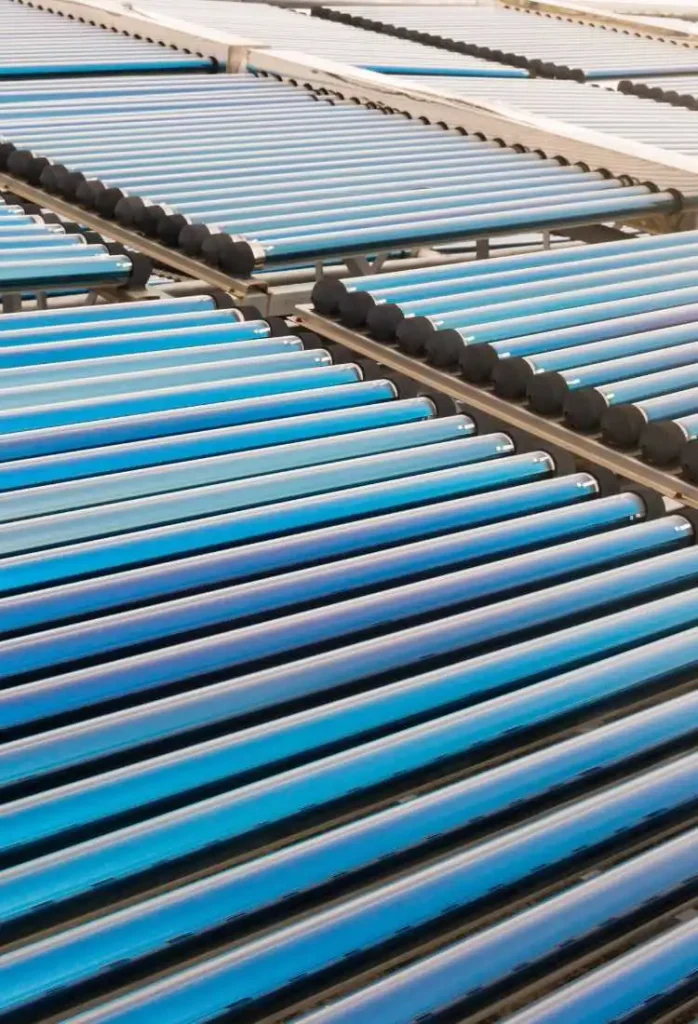
Evacuated tube collectors are a technology used in solar heating systems to capture the sun’s energy and convert it into heat. This type of solar collector is especially effective for operating in cold climates and cloudy days, offering high efficiency in converting solar energy into thermal energy. Its unique design allows solar energy to be harnessed more efficiently compared to flat-plate solar thermal panel systems.
What are evacuated tube collectors?
A evacuated tube collector consists of a series of cylindrical glass tubes that function as solar thermal collectors. These tubes are made of two layers of glass with a vacuum between them to act as a thermal insulator. This vacuum almost completely reduces heat losses by convection and conduction, making these collectors very efficient even in conditions of low solar radiation and low outdoor temperatures.
How do they work?
Solar Energy Absorption: Each vacuum tube contains an absorber (absorbing material) that captures solar radiation. This absorber is designed to capture a wide range of solar radiation, including visible, infrared and ultraviolet light.
Heat Transfer: Inside the vacuum tube, and in direct contact with the absorber, there is a heat pipe or conduit through which a heat transfer fluid circulates. This fluid is heated by the absorbed solar energy and transfers the heat to the water or fluid circulating in the solar heating system circuit.
Thermal Insulation: The vacuum between the two layers of glass in the tubes acts as an extremely effective insulator, minimizing heat losses. This allows evacuated tube collectors to be efficient even on cold or windy days, unlike other types of solar collectors that can lose a significant amount of heat under these conditions.

CSP: Concentrated solar power
Concentrated solar power (CSP) is a technology that uses mirrors or lenses to concentrate a large amount of sunlight onto a small receiver. This concentrated solar energy heats a fluid, which is then used to generate electricity in a conventional thermal cycle process. CSP is remarkably effective in areas with high direct solar irradiation and is used primarily in large-scale applications to generate electricity for power grids.
How does Concentrated Solar Power work?
The operation of CSP systems is based on four main components: the solar collector field, the heat receiver, the energy conversion system and the thermal storage system.
Solar Collector Field: Uses mirrors or lenses to concentrate sunlight. There are several types of concentrating technologies, including solar towers, parabolic troughs, parabolic dish systems, and linear Fresnel systems. Each has a different way of concentrating sunlight onto a receiver.
Heat Receiver: Concentrated sunlight is directed towards a receiver, where a heat transfer fluid is heated. This fluid can reach very high temperatures, often above 400 °C (750 °F).
Energy Conversion System: Hot fluid is used to generate steam in a heat exchanger. The steam generated is directed to a steam turbine, where the thermal energy is converted into mechanical energy and then into electrical energy by a generator.
Thermal Storage System: Thermal energy can be stored, often in the form of molten salts, allowing the plant to generate electricity when sunlight is not available, such as at night or on cloudy days. This improves the reliability and availability of power generated by CSP facilities.
Solar farms: Sustainable investment in renewable energy
Solar parks, also known as solar farms, represent one of the most promising and sustainable investments in renewable energy. These large-scale installations not only contribute significantly to clean energy production but also offer a profitable opportunity for investors interested in fostering a greener future. Below, we explore in detail what solar parks are, how they are developed, their advantages, profitability and required investment.
What are solar parks?
A solar farm is a large-scale facility where solar panels are mounted on extensive land to generate electricity by capturing the sun’s energy. These installations are designed to power numerous homes and businesses, contributing renewable energy to the overall power grid.
How to develop a solar farm
The development of a solar farm involves several essential steps:
- Site evaluation: Select a suitable site with optimal solar exposure and access to network infrastructure.
- Feasibility study: Conduct financial and technical analysis to evaluate the profitability of the project.
- Permitting: Navigate the regulatory process to obtain the necessary approvals.
- Installation: Install solar panels, inverters and grid connection systems.
Advantages of solar parks
Solar farms offer multiple benefits:
- Positive environmental impact: They reduce dependence on fossil fuels, reducing greenhouse gas emissions.
- Employment generation: They create numerous jobs during construction and installation, as well as in maintenance and operations.
- Affordable energy: They contribute to reducing the cost of electricity in the market.
Profitability and Investment
The profitability of a solar farm depends on several factors, including location, project size and available government incentives. Despite requiring considerable upfront investment, solar farms can offer:
- Attractive returns: Thanks to the sale of generated electricity and possible tax credits.
- Low operating costs: Solar systems have relatively low maintenance costs.
- Long-term sustainability: With a lifetime of solar panels exceeding 25 years, solar farms promise to be a long-term source of stable income.
Conclusion
Investing in a solar farm is not only an astute financial decision but also a commitment to the future of the planet. As the world moves toward greater reliance on renewable energy, solar farms are positioned as leaders in the energy transition. For investors, developers and communities, they represent a unique opportunity to contribute to a more sustainable world while benefiting from the growing demand for clean energy.


